


COP30 Reflection: Prophetic Voices from the "Global South" Demanding Climate Justice and Concrete Action
True hope is born from communities, not conferences. Together, we push toward a just and sustainable future.
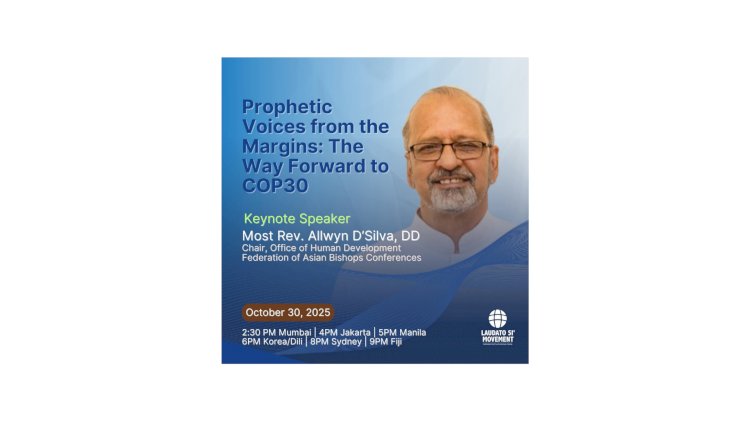
The Laudato Si' Movement held an international webinar titled "Prophetic Voices from the Margins: The Way Forward to COP30" on Thursday (10/30/2025).
This webinar highlighted the need for moral leadership and stronger demands for climate justice from countries in the Global South ahead of the 30th Conference of the Parties (COP) to the United Nations Framework Convention on Climate Change in Brazil.
This event featured keynote speaker Most Rev. Allwyn D'Silva, DD, President of the Human Development Office of the Federation of Asian Bishops' Conferences (FABC).
In his presentation, Bishop D'Silva explained the long-term collaboration efforts between the Churches on three continents: Asia (FABC), Latin America (SELAM), and Africa (SECAM). They decided that the preparations for COP30 would be a "learning ground for cooperation."
The goal is to produce a "joint text from the global South" that has three approaches: an executive summary, a synthesis, and a main document. This document is expected to be "used as preparation material for all Churches in Asia so that they can play an active role in COP-30."
Bishop D'Silva also referred to the FABC pastoral letter highlighting four important topics: "The suffering of our common home," "Signs of hope," "Concrete actions," and "A call for active involvement."
Prophetic Voice Means Action, Not Silence
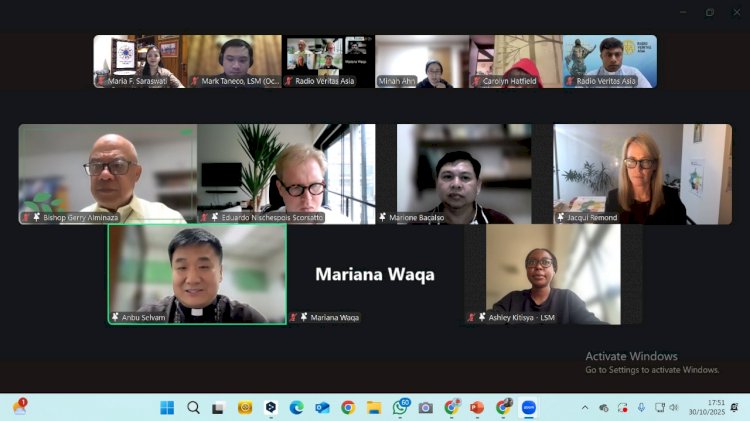
The webinar continued with a roundtable discussion featuring panelists from various parts of the Global South.
Bishop Jerry of the Diocese of San Carlos, Philippines, emphasized that being a prophetic voice in the midst of the climate crisis means "daring to speak truth to power, even when it is uncomfortable or risky."
"Being prophetic today means continuing to defend the cries of the poor and the cries of the earth," he said. "As leaders of faith, silence means complicity."
This view was echoed by Mariana Waka, a Fijian-Australian theologian. She called for accountability from "oil and gas exploiters" and emphasized that Indigenous communities around the world "know how to care for nature."
Climate Justice is Healing Historical Wounds
Panelists highlighted that the climate crisis cannot be separated from historical injustices.
Eduardo Scorsato, a young Catholic leader from Brazil, stated that climate justice is "more than just reducing emissions." For him, it is about "healing historical wounds and acknowledging the ecological and social damage" caused by "colonial development models."
Ashley, program manager of the Laudato Si' Movement in Africa, emphasized that climate justice "begins with honesty." "The African continent contributes only about 4% of total global emissions, yet it feels the greatest impact of climate disasters," she said.
She added that justice is not just about financial compensation, but about "restoring and rebuilding life systems." Mariana Waka strongly questioned the world's slowness. "How much longer must we dance, sing, and tell our stories for the world to hear the frequency of our struggle in the global South?"
She urged that COP30 "should not just be a political and economic arena for world leaders and multinational corporations pursuing their own interests."
From Moral Conviction to Political Action
The dialogue also emphasized the Pope's call as outlined in the discussion material. As the moderator reminded the audience, "Pope Leo XIV reminds us that ecological responsibility must lead to civil and political engagement." In response, Eduardo Scorsato emphasized the need to "integrate faith, science, and citizenship."
Ashley from Africa called for spirituality to be prophetic. "We can no longer separate faith from public life. Our spirituality must be political not partisan, but prophetic," he asserted.
In the Philippines, Bishop Jerry shared a concrete example, such as a parish that switched to solar panels on its roof, which successfully reduced its monthly electricity bill from 10,000 pesos to an average of 200 pesos.
Hope Comes from the Community, Not Conferences
Towards the end, the panelists shared their sources of hope. Jackie Raymond, co-founder of the Laudato Si' Movement, referred back to the Pope's teachings. "As Pope Leo reminded us at the Raising Hope Conference, a change of heart is what makes all this possible," she said.
Raymond emphasized that her hope also lies in transformation within the Church, particularly in elevating "the dignity of women and children" and creating a model of co-leadership.
Mariana Waka finds hope in "the unyielding resilience of our people." Her message is clear: "We are not drowning, we are fighting. We refuse to be refugees in a crisis that we did not cause."
Ashley concluded that hope is now "organized." "We will no longer be on the margins of this story, but at its moral center," she said.
Bishop Jerry closed with a powerful message that true hope is born from below. "Hope is not born from conferences, but from communities," he concluded.
Author: Saraswati


